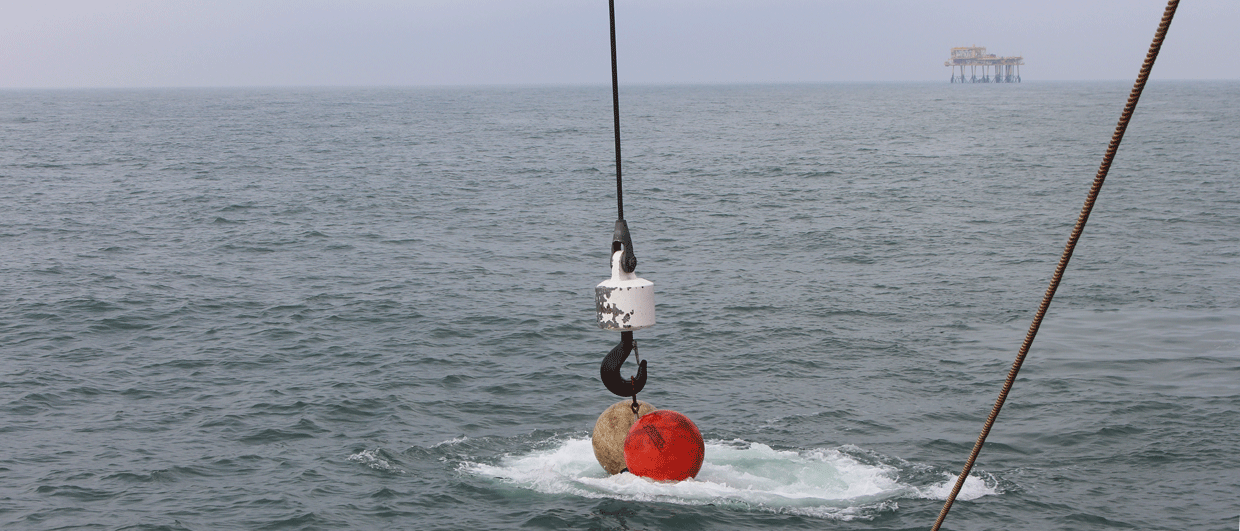
Static shooting on a calm day at sea – monitoring Perenco’s Leman CO2 injection test. Photography: Spotlight.
“In one year, we lost two years”
Habib Al Khatib talks openly about the current global CCS landscape and how his monitoring company Spotlight navigates this space

“Last year was not a very good one,” Habib admits when we meet on Teams. “Everybody expected that 2025 would be a turning point in the market, with many projects coming online. But unfortunately, that did not happen. And if you ask me when it will, I’m now inclined to say that it will rather be 2027 instead of this year. Hence, my statement that we lost two years in one.”
“Let’s face it,” says Habib, “there is pushback on the energy transition.”
But did he lose hope? Surely not. For two reasons. First of all, projects are moving ahead, and secondly, Spotlight has adapted to this new situation and has established a pre-FID service. For good reasons.
“Absolutely,” says Habib, “January last year – when the new US administration took seat – was a turning point in the CCS space, especially knowing that the USA was and still continues to be the biggest market of all. But at the same time, there is more clarity now, and there is still commitment. Projects such as Oxy’s Stratus and Exxon Mobil’s Rose are still going ahead.”
Habib also mentions datacentres and how these have very quickly become an attractive target for small-scale CCS projects. “We know that power is one of the main limiting factors for this rapidly increasing sector, and we also know that gas is still one of the most common energy sources. One and one is two.”
Similarly, Canada has reconfirmed its commitment to CO2 storage on the back of a drive to increase its exports of oil and gas. Europe is also moving forward, albeit slowly. Especially in the UK, where the government has made the commitment to guarantee a minimum CO2 price for the two Track 1 projects. “That is unrivalled,” says Habib.
OK, but given the project delays that we are still seeing, how does a company like Spotlight position itself in this market? At the end of the day, monitoring only takes place after project initiation. “We have now moved into the pre-FID space,” explains Habib. “If we can show, with the assistance of our flow modelling approach, how a plume of CO2 will move in the reservoir, we can build a strategy for phased plugging of legacy wells in the area, together with a robust monitoring system in place. That means a phased investment rather than a front-loaded one. That has big advantages.”
The big question obviously was how regulators respond to that. “Well,” says Habib, “we actually had one regulator telling us that they like this, because it allows more time to benefit from experience elsewhere on how to best plug these legacy wells. There is not a lot of experience in this field yet, and technology is advancing rapidly, so it may be good to wait a little longer.”
“I believe that we now have a service that is light and agile enough for what the market is asking for,” concludes Habib at the end of our conversation. “Combined with a series of recent successful projects, and what is in the pipeline, I believe that we are in pole position.”