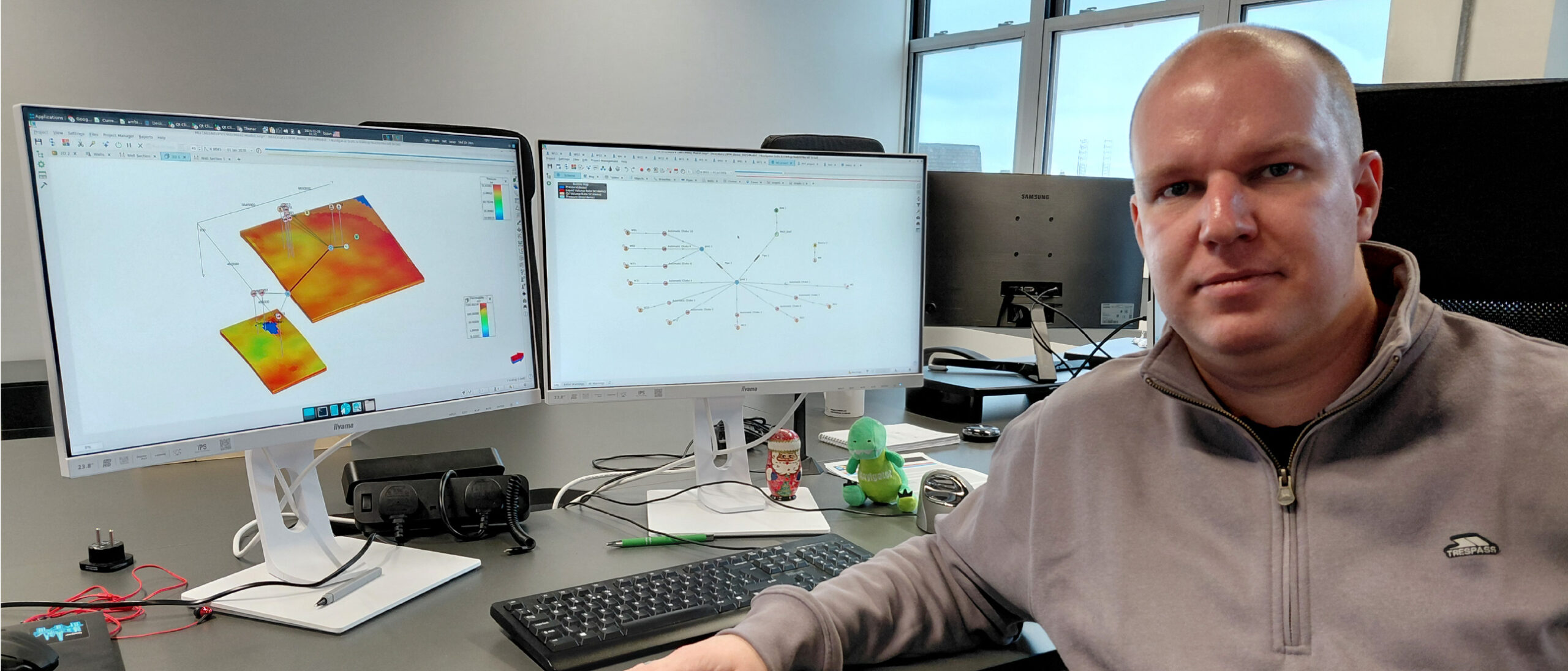
Alexey Danilko and an example of the screens he looks at during his working day. Photo: Henk Kombrink.
Producing more by producing less
Why reservoir simulations need to be carried out in combination with surface constraints to really know how to manage a field best

“The pressure in the separation unit, where the produced oil is separated from gas, is the ultimate driver for your entire field development approach,” says Alexey Danilko, production engineer at Rock Flow Dynamics, when we meet on a cold morning in Aberdeen, Scotland.
No, this is not something that many geoscientists will have sleepless nights about, but it is a very important factor indeed. “It is quite straightforward to understand,” says Alexey. “Because we need a wellhead pressure that exceeds the pressure of the separation unit – fluids need to flow into it – and the pressure of the separation unit is fixed, we can’t allow the pressure in the wellhead to come down too much either. In turn, this has a knock-on effect on the bottom-hole pressure too.”
Knowing this, it is easy to understand that running a reservoir simulation model without these surface constraints can result in a very different production profile than in a situation where you include these boundary conditions.
“For example,” says Alexey, “we worked on a field development study for a client in which the four projected development wells were all dead after a year of production if we had opened the taps to their maximum extent. The reason for that is the gas that is also in the reservoir and is co-produced with the oil, is also leading to a rapid pressure loss in the reservoir. This causes the wells needing artificial lift and additional investment to continue production.”
VALUABLE EXPERIENCE
Before he completed a master’s degree in petroleum engineering, Alexey spent five years with an operating company where he worked on the optimisation of wells and production facilities for an asset that was characterised by an oil rim overlain by a large gas cap. “Tweaking the wells to an extent that the surface facilities could both handle the gas as well as prevent water breakthrough or gas coning was very insightful for me; I still use what I learned there today.”
“To overcome issues like this,” continues Alexey, “we model both the reservoir dynamic side of the operation as well as the well completion and surface constraints to arrive at a scenario where we continue the natural depletion of the field as long as possible and thereby maximising the economic recovery. Sometimes, that means we have to choke the well head a bit.”
“Thanks to our software, we can now quickly find an optimal production scenario that comes up with the most efficient way of producing the hydrocarbons,” says Alexey. “Python scripts and AI form a key factor in that,” he says. “You don’t need to be a professional programmer anymore to be able to tell the software that under a certain scenario, a valve needs to be closed for a while. AI can write the code for us.” “That doesn’t mean we are redundant,” he says,” our expertise is still required to make sense of the final results. But now, we are able to test many scenarios and truly perform an integrated asset management approach.”