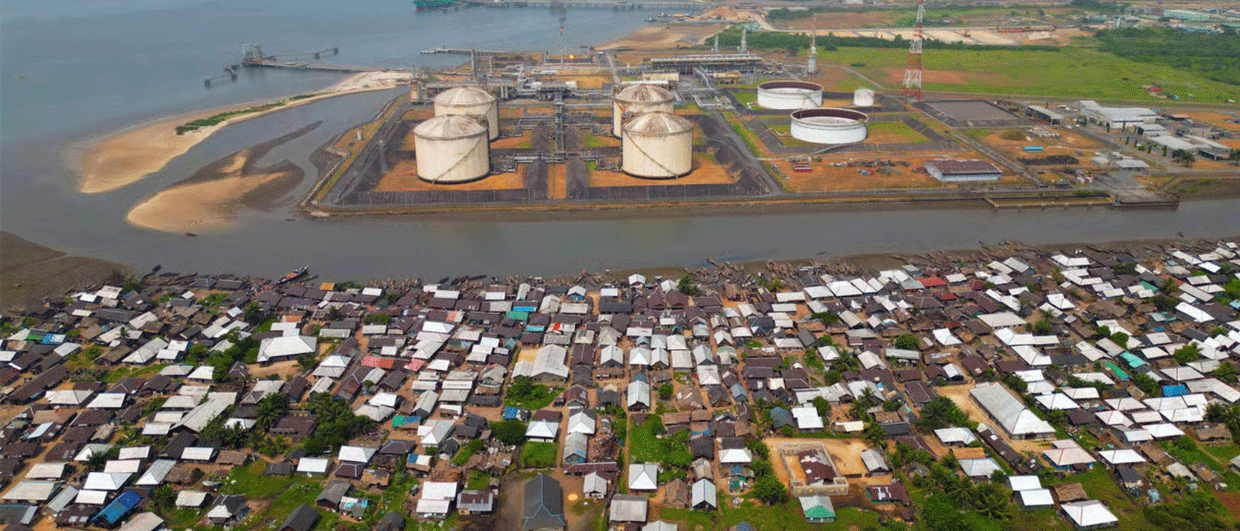

“To meet the economic demands of the Nation and mandates given by the Federal Government, we need to increase production,” says Johnbosco Uche, “that is one of our main targets for the years ahead.” Johnbosco is the exploration and geosolutions manager at Renaissance Africa Energy Company Limited (Renaissance), the new Nigerian oil and gas producer which, in March this year, acquired Shell’s onshore and shallow-water assets in the Niger Delta, becoming operator of Nigeria’s largest oil and gas exploration and production joint venture – the NNPCL / Renaissance / TotalEnergies / Agip Energy and Natural Resources Joint Venture.
In his position, Johnbosco oversees activities across 18 Oil Mining Licences (OMLs) that have all seen various levels of development over several decades.
Johnbosco knows the assets well; he was formerly employed by Shell, as many of his Renaissance colleagues were. But with the transition to the new company came more of a focus on the Nigerian assets. “That is only a good thing,” says Johnbosco, “because now, we have more of an incentive to critically look at these licences and evaluate their full potential, whilst, before, it was easier for Shell to redirect investment to other international parts of their portfolio.”
“Given the advancements in technology, the quality of the seismic data we have is now dated,” Johnbosco continues, “except from some more recent data that we acquired in shallow waters in 2019.” For that reason, there is a strong belief amongst the leaders in the company that new data is required for many of the licences to identify and de-risk new drilling opportunities, all geared towards increasing production.”
“We are looking ten years ahead,” says Johnbosco, “with a concrete plan in place for the first five years to come.” Expectedly, the second part of the ten-year plan will then be driven by the successes of the first phase. The company has kicked off the process for commissioning seismic surveys to acquire over five licences for now, using longer offsets than previously applied. “We are looking at 9 km offset seismic data, whilst before this was in the region of 3 to 4 km,” Johnbosco explains. “This should enable us to image and map our deeper prospects with more confidence than we did before.”
In the shallow water licences, Renaissance will work with OBN acquisition. This was also done for the 2019 survey, which has resulted in additional infill drilling opportunities. “As the new seismic data will come in for processing and interpretation, we will also ramp up our drilling activity on the back of that,” continues Johnbosco. “We plan to drill two to three exploration wells per year post seismic acquisition, processing, and interpretation.”
For Johnbosco’s colleague and Chief Technical Officer at Renaissance, AbdulRahman Mijinyawa, Renaissance and Nigeria have a great opportunity to extend the life of the Niger Delta basin towards realizing Renaissance’s vision of becoming the African energy leader, enabling energy security and industrialisation in a sustainable manner.