

The Chinese are quite good at issuing press releases at interesting moments, and the one announcing the discovery of 100 M t (around 720 MMbbl) of oil in the Bohai Basin is yet another good example. Published on the 24th of December, Christmas Day, CNOOC made public the results of the Qinhuangdao 29-6 well, which reportedly tested at 2,560 barrels of oil per day.
The press release was copied by numerous outlets, without any attempt to put this discovery in context. As such, the reader is left to believe that around 720 MMbbl of newly discovered oil is now ready for development. Quite a large find.
However, a quick look at some published data reveals a different and more complicated picture. And even when these publications predate the completion of the Qinhuangdao 29-6 well, it still forms a very good basis to make some inferences as to what this discovery is really about. As well as the challenges it may face before it’s put into production.
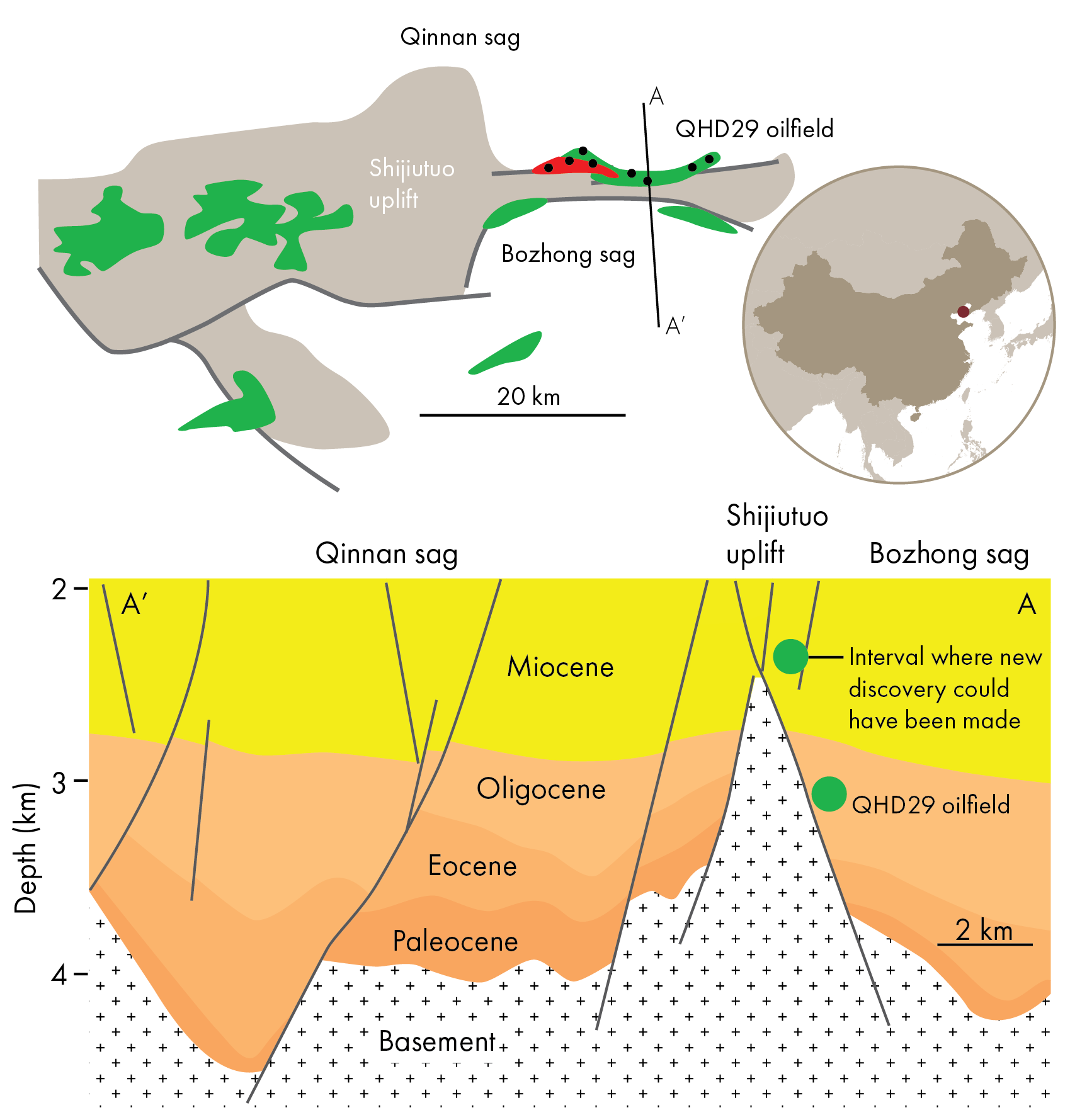
First of all, the well name already suggests that this is not the first well drilled on the Qinhuangdao structure. In fact, Qinhuangdao 29 is the name of a field that already exists, on the flanks of the Shijiutuo uplift. The most important reservoir in this field seems to be Paleogene sands, slightly deeper than the Neogene intervals mentioned as being the main reservoir in the press release.
So, with wells already present in the area, would it be possible that the Neogene oil was already known prior to drilling Qinhuangdao 29-6 well? Quite likely; as an illustration (Figure 7) from this paper seems to suggest. And that is no miracle; rather the contrary.
Then, there is another interesting aspect to this discovery, and that is the observation made in this paper about the CO2 contents of the hydrocarbons found in this area. Migrating upwards through deep-seated faults, this gas must pose a challenge to the economics of the development, if not to the CO2 footprint of the project.
In other words, a ten-minute search is enough to find out that this discovery is not unexpected – it could even be that the heavy oil was already known before drilling the well. In addition, potentially high-CO2 contents may pose a risk to the development. All in all, this “discovery” fits the picture of a move towards more complicated hydrocarbon accumulations as the easier once deplete. Something that we see all over the place.
CNOOC was approached to clarify the comment quoted in the press release: “This achievement challenges the conventional understanding that slope areas merely serve as pathways for hydrocarbons rather than sites for substantial accumulation.” A reply was not received.