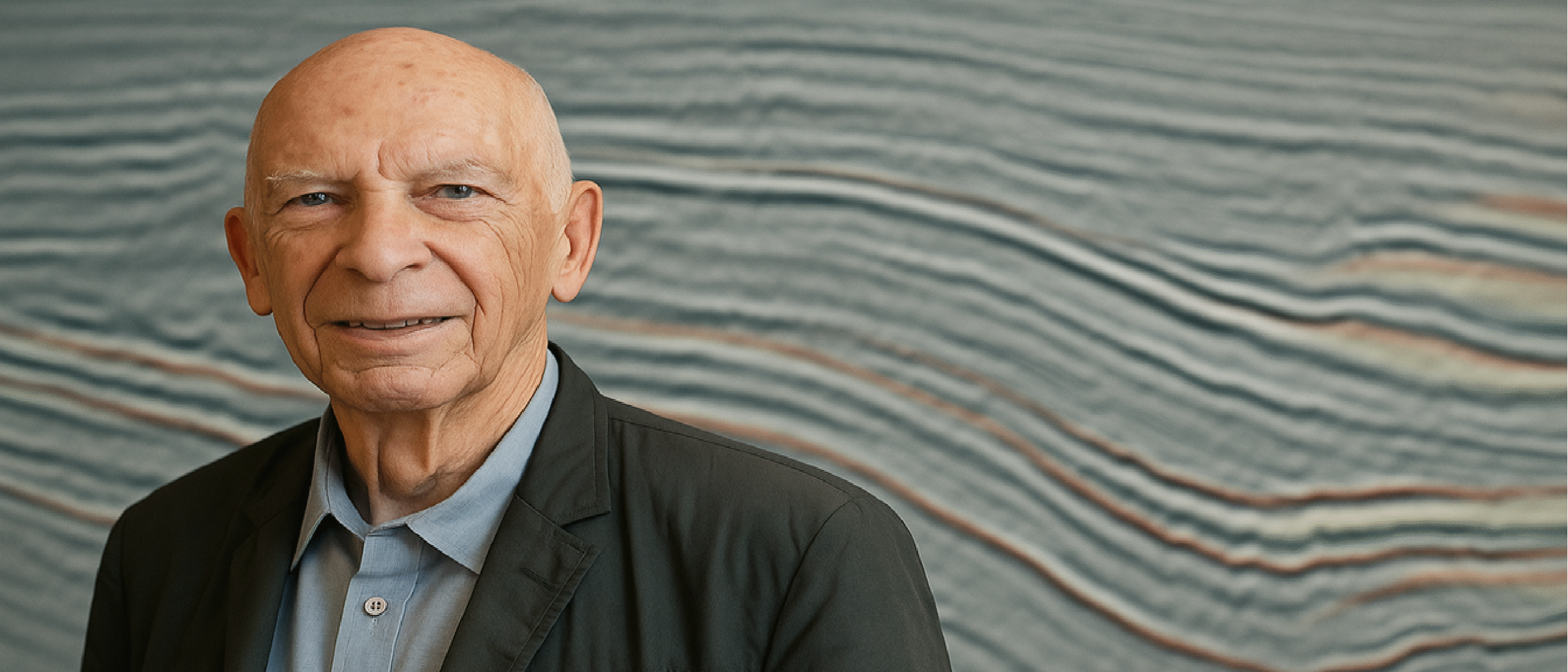

“I’m a petroleum engineer, but I’ve been in the exploration and seismic business since the 1970s,” says Rafael when we meet on Teams a week before the IMAGE Conference in Houston.
“We were one of the first to digitise analogue seismic, not by tracing the reflections, but by using a military fax – a game-changing device at the time. Then I was involved in setting up a seismic processing centre with Shell in Venezuela, which took up a few years of my career. However, when 3D seismic arrived, the computer power to process the data increased so dramatically that I could not afford the workstations required for it.”
Then, Rafael got more involved with investing in oil and gas exploration, which ultimately triggered the idea that led to the business venture he is now part of: XploroilgasAI.
“I had seen so many reports from investors marketing a prospect, but hardly ever was there any technical detail on the three parameters that ultimately determine the economic value of a discovery: Porosity, permeability and water saturation,” Rafael says. “These are the parameters that determine the size, production potential and production (income) profile of the prospect.”
The seismic velocities that can now be calculated through FWI are really at the basis of our workflow. Now that we are there, we have expanded our toolbox to such an extent that we will be able to use the data itself rather than analogues to inform ourselves about the field-wide variation in porosity, permeability and water-saturation
“The industry is used to AVO analysis,” continues Rafael, “but the problem with AVO is that it is mostly used for gas in siliciclastic reservoirs. The methodology has not proven to be very effective when it comes to oil, and neither for carbonates.” Rafael adds that their technology, which relies on seismic velocities, can be applied across the spectrum of different reservoirs and applies to both oil and gas.
Then, I ask Rafael about the aspect of non-uniqueness – alluding to the observation that the same AVO signal can be explained by different combinations of porosity and gas saturation. How does the same phenomenon impact the results of his analysis? “We’ve got solid correlations between Vp and porosity for oil, which we have obtained by looking at more than 150 fields and over 140 of lab-generated cores,” says Rafael. “Vp values below 10,000 f/s are a strong indicator of gas accumulations. Other fluids like unconventional heavy oils also have low Vp values but geologic logic clarifies this duality.”
“We are currently working on the Wilcox play in the Gulf of Mexico, where we can now extract porosity, permeability and water saturation from any location in the dataset we’ve got,” continues Rafael.
“The seismic velocities that can now be calculated through FWI are really at the basis of our workflow,” Rafael concludes. “The maths have been around for decades, but we simply lacked the computing power to come up with satisfying results. Now that we are there, we have expanded our toolbox to such an extent that we will be able to use the data itself rather than analogues to inform ourselves about the field-wide variation in porosity, permeability and water-saturation. In turn, this will translate into a much better handle in the investment risk that comes with putting your money on the table for an exploration well.”