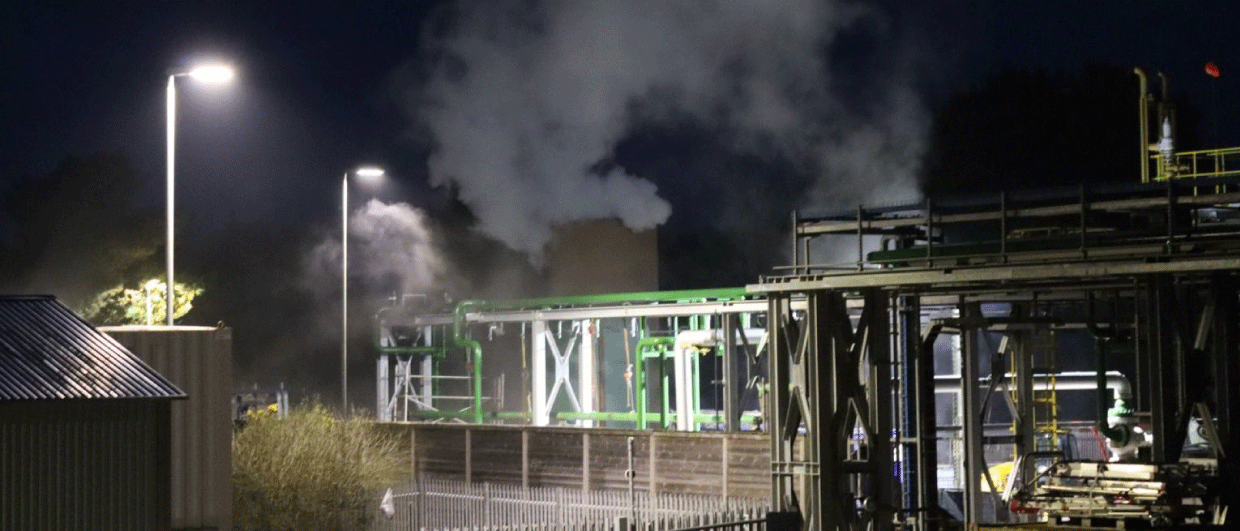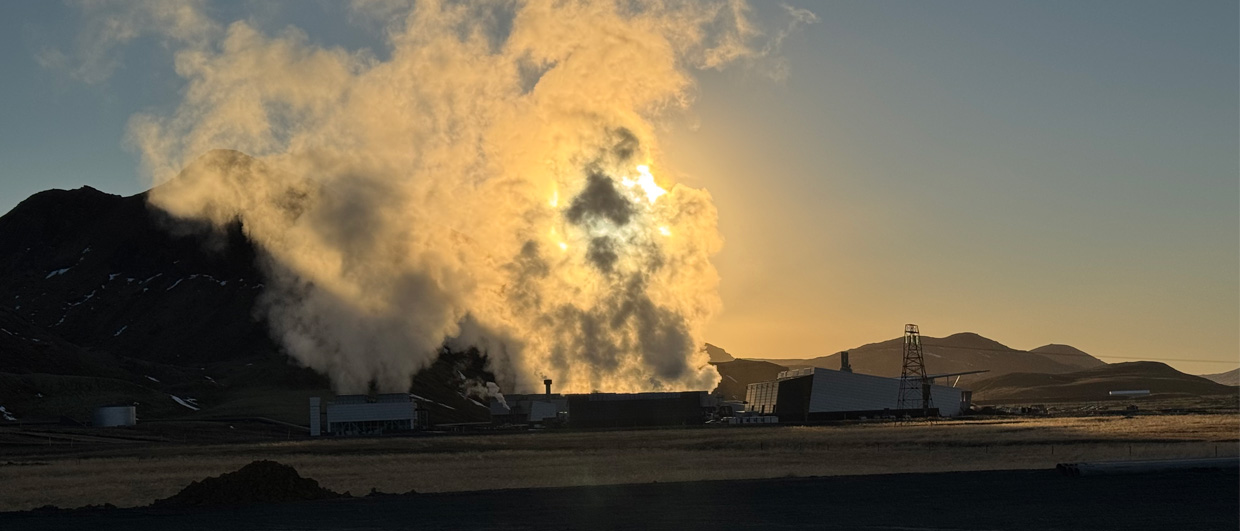
Hellishöfði Geothermal Power Plant. Photo: Susan Fellows.
Where the earth yawns
Susan Fellows reports on a recent visit to a geothermal powerhouse

I first visited Iceland a decade ago. Recently, I returned, courtesy of a European Geothermal Research project, hosted by Reykjavik Energy. We learned about heating and electricity production in Iceland, and visited both low-temperature and high-temperature installations, including the Hellishöfði Geothermal Power Plant, famous for the Carbfix project.
At Hellishöfði, electricity is produced using 300° C steam, which powers seven turbine units, each connected to a generator, producing over 2,300 GWh of electricity per annum. Extracted gases from the geothermal liquids and CO2 from a co-located Climeworks DAC installation are dissolved in the disposal water of the geothermal plant and reinjected into the underlying basaltic bedrock at a depth of 750 m. Over the next two years, the CO2 is transformed into calcite, and the hydrogen sulphide into pyrite.

High-temperature geothermal water cannot be used directly for house heating, but instead, is used to heat cold water to 80° C. Hot water production amounts to 14 Mt/yr. A 25 km long pipeline connects Hellishöfði to Reykjavik, with the average heat loss on the way to Reykjavik being less than 2° C. Adjacent to Reykjavik, low-temperature area pumping stations deliver hot water to the district heating system directly from the ground. 99.9 % of homes in the Reykjavik area are heated with geothermal heat. Central heating is the predominant element in Icelandic energy requirements, with the length of the district heating system in the capital area itself being more than 3,000 km, equivalent to the distance from Reykjavik to Milan.
A memory from my first visit: The ‘Bridge between the Continents’, not marked, but unmistakable: Where the great mid-Atlantic Ridge strides ashore. The earth blatantly ruptured and split. Sudden nerves. The rift is not a hole down which I can fall to the centre of the earth. Yet, feet sinking in unexpected sediment, I am acutely aware that at this very place the earth is rather less than solid; the knowledge that here, beneath my feet, the earth yawns.
SETTLING DISPUTES
The Icelandic Parliament, the Althing, was established at Þingvellir in 930 AD. Pingvellir sits directly on the mid-Atlantic Ridge, being a rift valley where the boundaries of the continents are visibly expressed as a dramatic network of fault lines and gorges. The Althing is widely considered one of the oldest formal political assemblies in the world, and one assumes that the Icelanders of the time simply viewed the impressive setting as a worthy location to create laws and settle disputes, though presumably interrupted on occasion by seismic events of a different nature and scale. In the 19th Century, the Icelandic Parliament relocated to Reykjavik, a more stable location geologically, if not perhaps politically.