Leading the wave: Environmental impact assessment for offshore geophysical operations
By offering a credible, science-based foundation for early planning and decision-making, EIAs help to differentiate between perceived impacts and genuine risks or conflicts that necessitate mitigation and management

Environmental Impact Assessments, or EIAs, are a critical tool for evaluating the potential effects of human activities. As geoscience activities grow increasingly complex and expand into frontier regions, EIAs are essential to identify and mitigate possible risks to wildlife, ecosystems, and the human communities that depend on these resources for economic, social, and spiritual well-being. Industry bears the responsibility to ensure that these resources are safeguarded.
A well-structured EIA enables operators to manage and mitigate environmental risks, meet permitting expectations, and build trust with regulators, stakeholders, and the public. While EIA requirements vary dramatically across jurisdictions, the central aim – protecting the natural environment and the people who depend upon it – remains constant. For geoscience activities, these risks may include emissions, spatial use conflicts with other ocean users, underwater sound, and biological interactions, among others.
Many jurisdictions require some form of an EIA – sometimes referred to as Environmental and Social Impact Assessments (ESIA), Strategic Environmental Assessments (SEA), Environmental Impact Statements (EIS), Environmental Plans (EP), or other variations. With the variation in names, however, also comes variation in expectations for content and level of detail. This can create misalignments in expectations between project proponents, regulators, and stakeholder communities. When managing questions pertaining to underwater sound and the complex physical and biological factors with which it interacts – this balance becomes an even greater challenge.
Supporting exploration
Through reliable science- and data-based regulatory advocacy, credible resources and expertise, and future-focused leadership, EnerGeo Alliance (EnerGeo) continuously works to help shape informed government policies that advance responsible energy exploration, production, and operations. We provide our members with relevant and timely topical events, seminars, news, and a range of educational, scientific, and regulatory tools and information to support the exploration and development of mainstay, alternative, and low-carbon energy solutions. EnerGeo’s vision is to be the most credible and effective voice for promoting and ensuring a safe, environmentally responsible and competitive energy geoscience industry. To support this vision, we have developed a comprehensive EIA Guidance Suite to help project proponents and regulators prepare EIAs that meet these essential objectives.
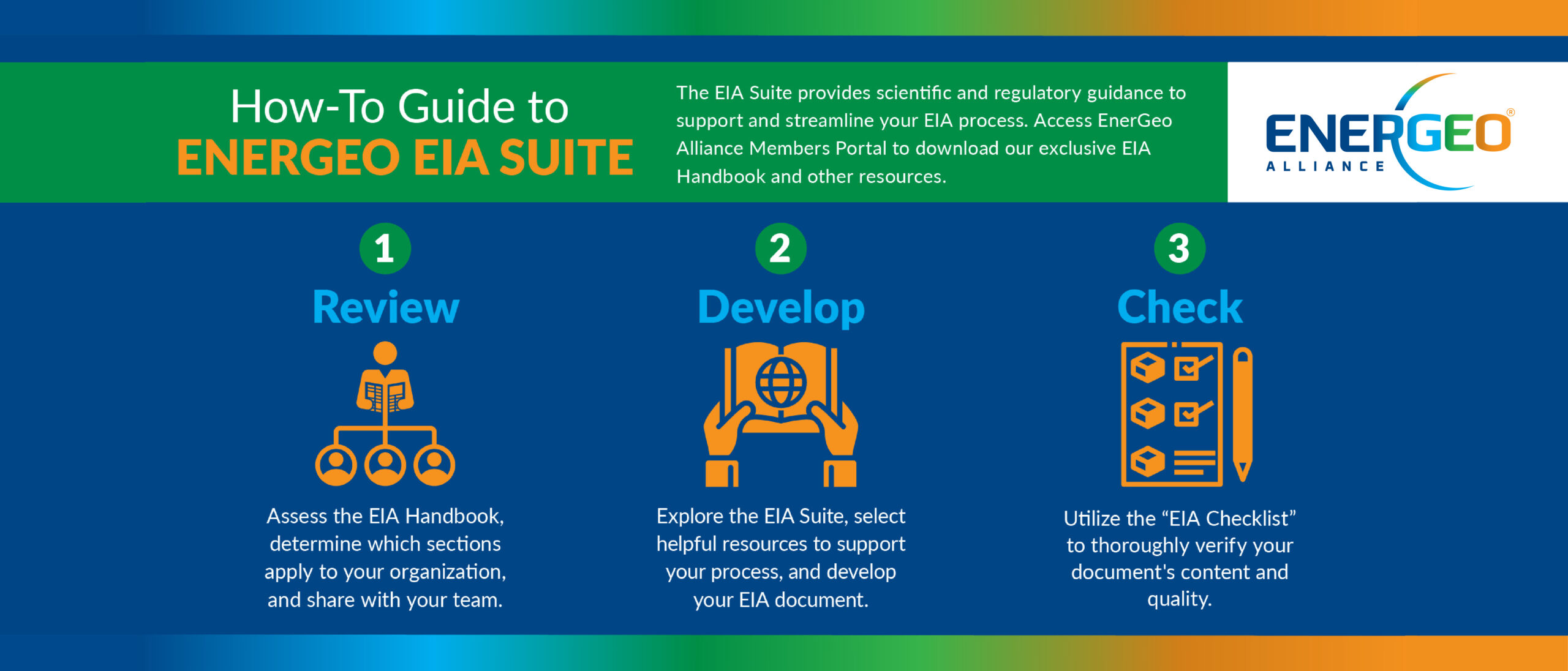
 These member-exclusive resources are intended to support companies as they navigate complex and inconsistent regulatory landscapes globally. The EIA Suite consists of a number of resources for members and their supporting contractors, including: Our flagship EIA Handbook; Stakeholder Engagement Guidance; Global Seismic Regulations Summary Spreadsheet; a curated set of EIA Resources; an EIA Preparation Checklist; and various fact sheets and literature summaries covering a diverse array of technical topics.
The EIA Handbook offers step-by-step guidance tailored to the unique risks and requirements of geophysical surveys. Updated regularly and available in English, Spanish and Portuguese, the EIA Handbook addresses all aspects of the EIA process from preparation through stakeholder engagement, prompting best practices and scientific rigor while discouraging impractical requirements or requirements that are not supported by evidence. This includes template language intended to clearly convey the complexities of geophysical equipment, operations, and underwater sound.
Preparation resources – including a Global Regulations Summary Spreadsheet, a list of EIA Resources, and fact sheets – facilitate an efficient development process. The EIA Checklist covers each step of the process comprehensively, allowing companies to either develop EIA documents internally or share these resources with their contractors. EnerGeo’s EIA Suite promotes industry-wide alignment and ensures the use of the best available scientific information in EIA development worldwide.
Contact with communities
Preparing a document, however, is rarely adequate to satisfy obligations with local communities. Stakeholder engagement may be required in certain areas, or it may be in a project proponent’s best interest to engage with the relevant communities. Particularly in frontier areas, geoscience operations are generally the first contact communities have with the energy industry, and creating an open dialogue early in the process is generally beneficial as exploration and production proceed. EnerGeo’s Stakeholder Engagement Guidance is intended to shape a mutually beneficial process for working with diverse stakeholder groups.
A valuable resource for regulators
While developed for EnerGeo members, the EIA Suite also serves as a valuable resource for regulators. EnerGeo’s government affairs and scientific subject matter experts often engage with regulatory agencies to share these tools. By providing a neutral, science-based benchmark for EIA preparation, regulators can more efficiently determine whether submitted documents satisfy their environmental evaluation requirements. Clear, consistent standards for EIA documents also streamline the process for industry—both during the development phase and throughout regulatory review.
EnerGeo’s extensive government affairs and scientific expertise have generated valuable lessons for ensuring an EIA process that benefits industry, regulators, and community stakeholders alike. Members are encouraged to engage early and consistently with regulators and stakeholders, presenting technical information in clear, accessible terms. Integrating both local and global expertise is essential to developing a robust and context-appropriate evaluation. Project proponents are encouraged to allow sufficient time for scoping, data collection, and analysis, while proactively proposing mitigation measures that are effective, operationally feasible, and aligned with real risk.
Not a checkbox exercise
As expectations for environmental performance evolve, the EIA Suite will continue to be updated to reflect new scientific insights and regulatory requirements. It embodies the industry’s shared commitment to minimising impacts, enhancing transparency, and driving continuous improvement. Above all, EIAs should never be viewed as a mere checkbox exercise. When applied thoughtfully, they provide a meaningful framework to reduce risk, build trust with regulators and stakeholders, and support safe, successful operations. By promoting sustainable geoscience practices, EnerGeo members will continue advancing our mission for years to come – together, we are Making Energy Possible®.
For more information, contact info@energeoalliance.org