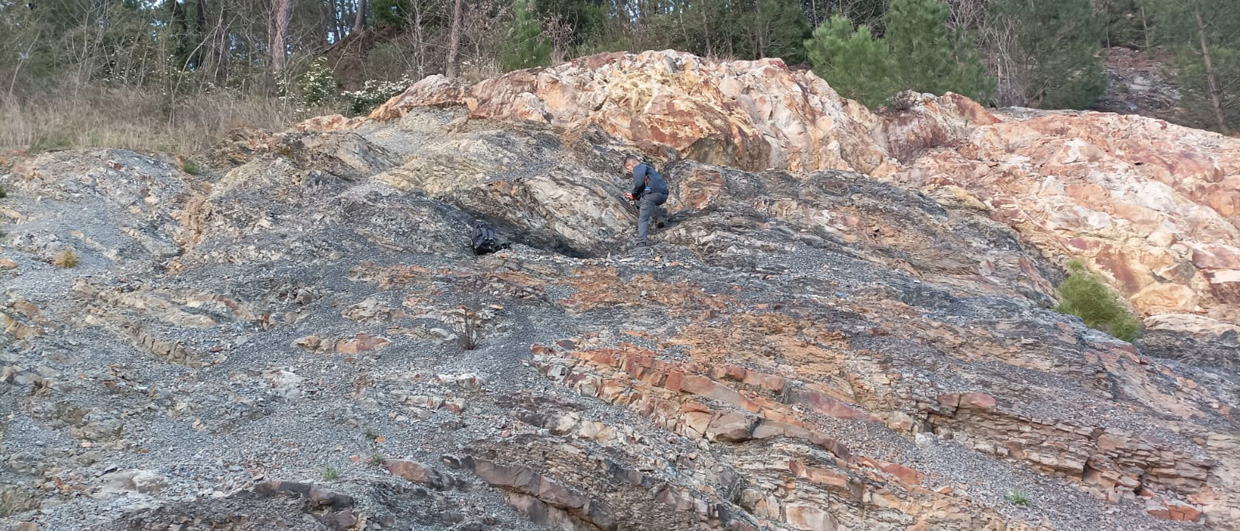
Carboniferous coal seam near Alès (southeastern France). Hydrogen has been measured in the waste of the Alès coal mine. Photo by Dr. Lévy. On the outcrop is Mr. Amrane, who was an M2 student at the time.
Quantifying the hydrogen-generation potential of iron-bearing rocks
The makers of the Rock Eval machine have developed a first prototype of a device to analyse the hydrogen potential of basement rocks

Everyone working in basin modelling and geochemistry knows what Rock Eval machines do; they provide data on how much organic carbon is in a source rock sample, how much has already been generated, and what the remaining potential is.
But the world is moving beyond oil, at least that’s the plan, and the developers of the Rock Eval machines are aware of that. For that reason, they have now built a machine that is capable of measuring the hydrogen-generating potential of iron-bearing minerals.
To achieve this, the team, which is deeply rooted in organic geochemistry, first developed a method to obtain hydrogen data from organic source rocks. I met with Nicolas Bouton from Vinci Technologies at the Image Conference in Houston to learn more.
“Our story starts in the south of France,” says Nicolas, “at an old coal mine tailing.”
“Isabelle Moretti, who used to be ENGIE’s Technical Officer and who started promoting hydrogen even before it became a hype, collected some coal fragments from the tailings, thinking that the maturation of coal should also generate hydrogen.”
Having a machine that helps calculate the generative potential of a mass of rock brings us closer to putting a number on a ‘prospect’, which is where we need to go

And she was right; the Vinci Technologies team managed to fit a hydrogen detector on one of their Rock Eval machines and was able to measure the hydrogen generated as the coal fragments were heated up.
“However,” Nicolas added, “the temperatures at which the hydrogen is generated are very high, with a Tpeak around 800° C, at 25° C/min. If we would extrapolate that to the field, there are not that many places in the world where one could expect coal at reachable depths where these conditions are met.”
“There are two places where this could be an option,” he continues, “Australia and China, but even there, the economics are probably unfavourable for large-scale drilling that would be required to get the hydrogen out. If it hasn’t migrated away.”
Then, the team realised that iron-bearing minerals, such as those found in ophiolites, are a better candidate for analysis. Interaction with groundwater makes these rocks produce hydrogen, which is currently being produced in places like Mali, and at relatively shallow depths of less than a kilometre.
“So, we started collecting samples and designed a machine that enables the throughflow of water,” says Nicolas. “That was the biggest change we had to implement to set into motion the process that also happens in the subsurface. But we succeeded, we captured the hydrogen peak, and we patented the process,” he says. “It was a great moment.”
“We are not there yet,” concludes Nicolas. “We are now entering into a Joint Industry project to translate the findings in the lab to what happens in the field, where these reactions take place at lower temperatures.”
“And we need to deliver,” he says, “because explorers are watching with interest. Having a machine that helps calculate the generative potential of a mass of rock brings us closer to putting a number on a ‘prospect’, which is where we need to go.”